
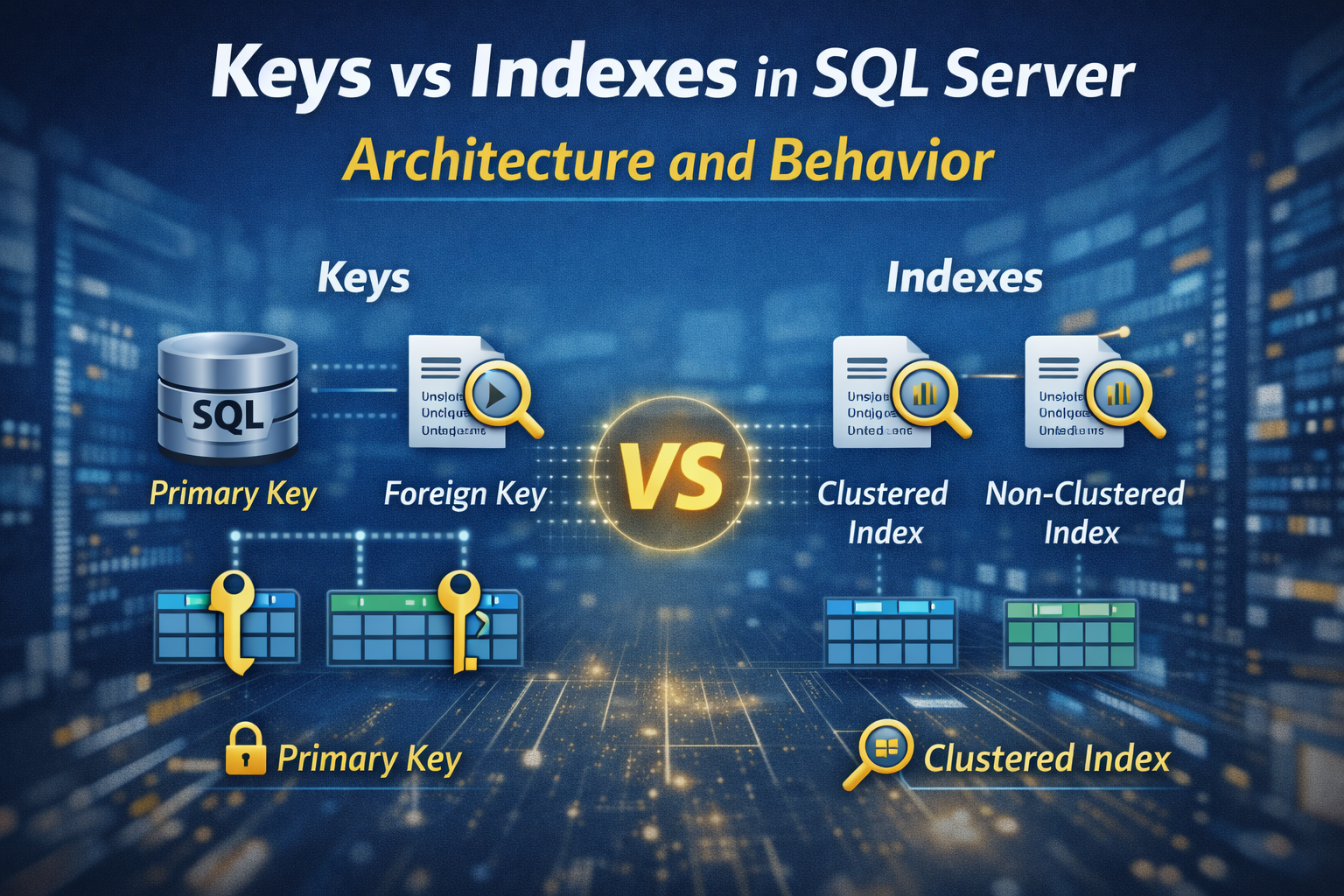
In SQL Server environments, confusion between keys and indexes remains a common and often overlooked issue. Although closely related, keys and indexes serve different purposes, and treating them as interchangeable can lead to design decisions that have unintended consequences.
When the distinction is not clearly understood, it can result in duplicate indexing structures, unnecessary I/O operations all of which directly affect system performance and maintenance.
These issues often go unnoticed because SQL Server automatically creates indexes to enforce certain limitations.
This article aims to clarify the relationship between keys and indexes in SQL Server by explaining what actually gets created internally when each is defined, and understanding this behaviour is essential for effective performance stability.
Key Definitions
- Primary Key: Enforces uniqueness, does not allow NULLs, one per table
- Unique Key: Enforces uniqueness, allows NULLs, multiple per table
- Clustered Index: Defines the physical order of data, one per table
- Nonclustered Index: Separate structure that references table data
Keys represent logical constraints, while indexes are physical structures used to enforce them.
Primary Key on a Heap Table
Creating a primary key on a heap results in the creation of a clustered index by default. This clustered index is used to enforce the primary key constraint.
Clustered Index Without a Primary Key
Creating a clustered index alone does not create a primary key. Indexes do not imply constraints.
Primary Key on a Table with an Existing Clustered Index
If a clustered index already exists, creating a primary key results in a unique nonclustered index. If the primary key is defined on the same column as the clustered index, this leads to a duplicate nonclustered index.
Dropping Indexes Enforced by Keys
Indexes created to enforce primary or unique keys cannot be dropped independently. The key constraint must be dropped first, which automatically removes the associated index.
Unique Key Behavior
Creating a unique key always results in a unique nonclustered index, regardless of whether the table is a heap or clustered.
Conclusion
A clear understanding of how SQL Server implements keys and indexes is fundamental to building reliable, maintainable, and high-performing database systems. While keys and indexes are closely connected, they address different concerns.
Keys exist to protect data integrity, ensuring that business rules such as uniqueness and entity identification, whereas indexes exist to optimize data access and query performance.
When these concepts are not deliberately planned, SQL Server may create additional indexing structures automatically to enforce constraints.
Although this behavior is correct from an engine perspective, it can lead to redundant or overlapping indexes, increased storage consumption, longer maintenance windows, and unnecessary overhead during data modifications. Over time, these inefficiencies accumulate and can affect system performance and stability.
By understanding what SQL Server creates internally and why, database professionals can make informed design decisions that balance integrity, performance, and maintainability.
Ultimately, investing time in understanding the relationship between keys and indexes leads to cleaner designs, more predictable behavior, and database systems that remain efficient and manageable as they grow.
